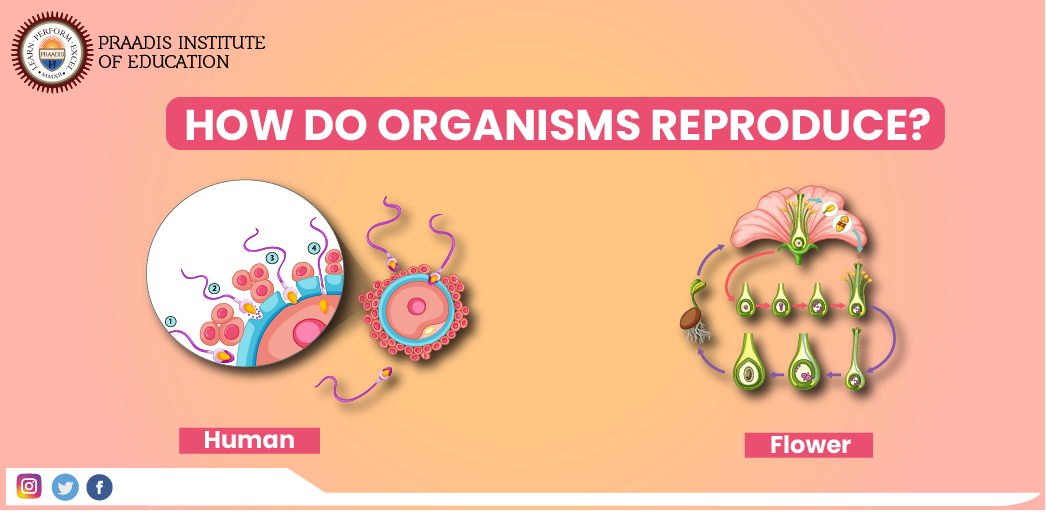
HOW DO ORGANISMS REPRODUCE?


Introduction In the chapter ‘How do organisms reproduce’ of biology from class 10 we are going to learn how reproduction takes place in plants and animals both sexual and asexual. We are also going to discuss reproductive health in which we will discuss sexually transfer diseases. We will also learn about childbearing and women's health. In this chapter of class 10, we will learn and understand every basic and important detail about the topic of reproduction. This chapter is very helpful for students of class 10 and in exams, this topic will help you to get high grades. So let us start with what is reproduction?

HOW DO ORGANISMS REPRODUCE?

What is reproduction?

Reproduction is a biological process in which an organism gives birth to a new organism that looks like the organism. The process of reproduction takes place in different living organisms, whether it is a plant or an animal. Every organism reproduces differently in order to maintain its species. This is a very important process that protects the organism from being eliminated from the world. After that, we get information about why reproduction is so vital. The process of reproduction is important because every living being is going to die one day and to maintain the species in the world, reproduction takes place. Among single-celled organisms, s.................   read full Article - https://praadisedu.com/blog/how-do-organisms-reproduce

or 

Click Here

Comments

Popular posts from this blog

Is a Bagless Education Better than a Traditional Education?

The overload on books by private schools is almost double of what is required by NCERT. But with PIE there is no need for books because all the content of the textbook is inside a mobile application on a smartphone that fits in your hand. Students don't learn more just because they have more books! The huge number of textbooks required by schools is ridiculous and has no impact in a student’s actual education. It just seems as though children will learn through osmosis – just put the book to your head and it sinks in. They point of an education is to mold a child into a critical thinker and well-rounded adult – not turn a child into an encyclopedia. Facts show that with the rise in private schools in India that the requirement of school books has also increased. All this creates undue pressure on students. Students schoolbags are getting heavier year after year. For a KG student, the requirement is to purchase around 10 – 12 books that need to be brought to and from schoo...

How Rote-Learning Destroys the Thinking and Analytical Capability of Students

Generally speaking, many believe that memorizing concepts through repetition is how learning takes place. This technique for learning is classified as "rote learning". Many believe this is the only way to secure good grades. Is rote learning an obsolete method or is there a legitimate spot for its utilization in the classroom today? Progressively, rote learning is being surrendered for fresh learning approaches utilizing digital learning apps, educational gaming, and personalized learning. Is repetition reducing your child's creative thinking and analytical skills? Creativity is the capacity to concoct new, unique, and special answers for everyday issues or situations. It utilizes divergent reasoning, which is a thought process that involves a spontaneous, free-flowing, and non-linear flow to reach numerous conceivable solutions. This is the opposite of concurrent reasoning, which is characterized by tackling issues in an isolated manner not taking...